
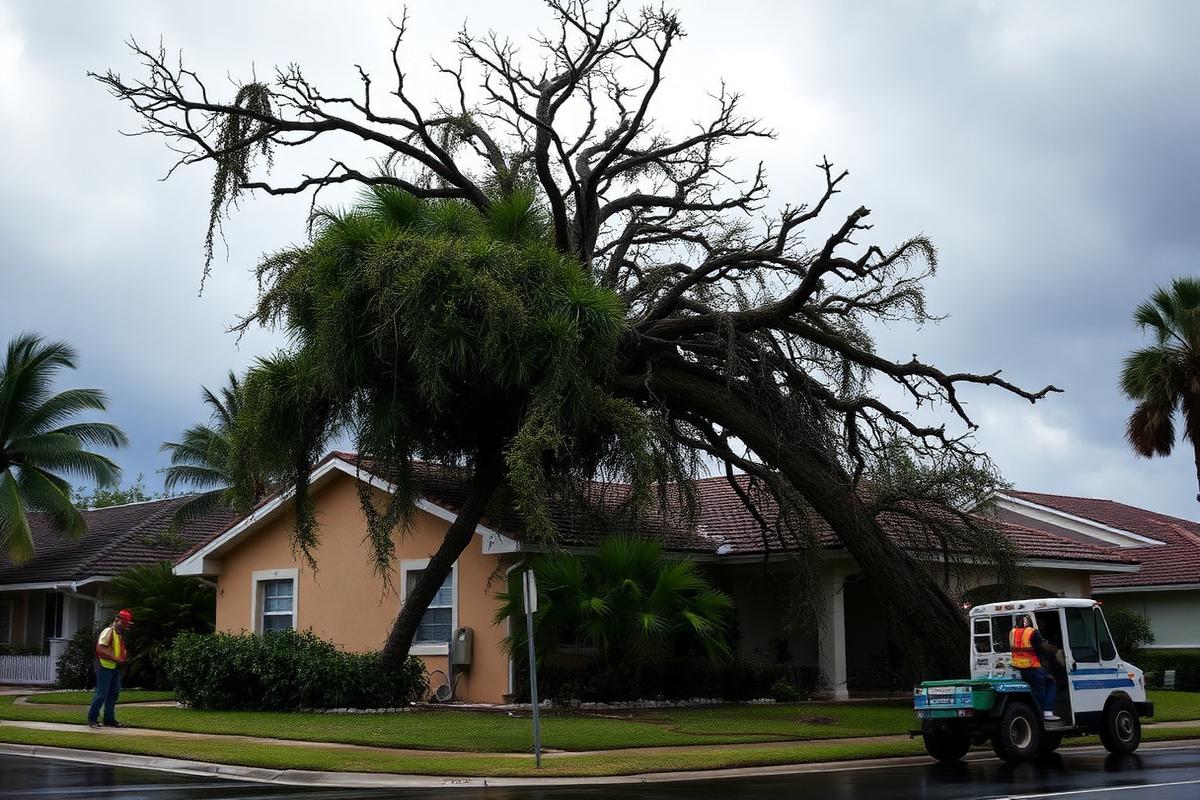
Before you submit - stay clear of these
Assume any line in or near a downed tree is energized, including the cable and phone lines that ride beneath the primary. Utility crews clear the conductor first; nobody should be cutting around it.
- Downed or contacted power lines - report those to your utility first
- A trunk under load or spring tension across a fence or vehicle
- Any limb hanging unsupported in the canopy after a storm
- Ground that has lifted or cracked on the windward side of a trunk
What we handle
Trees on roofs, lanais and pool cages. Trunks blocking driveways and access. Hangers and broken leaders left in the canopy. Uprooted trees with an unstable root plate. Post-storm cleanup where a lot has multiple failures at once.
Work is documented with photographs as it proceeds, which is what most insurers want to see for a claim.
Why Bay area trees fail
Sandy soils over a high water table give shallow root plates very little to grip once several inches of rain have fallen. Add sustained wind and the failure mode is usually the whole plate rather than the trunk.
Species matters too. Laurel oaks decay from the inside long before the canopy thins, so a tree that looked healthy in May can shed a leader in July. Sand pines and over-mature Norfolk Island pines are similarly prone to snapping mid-stem.
After the immediate risk is handled
Once a lot is safe, the remaining question is whether the tree can recover. Storm-damaged trees that keep a sound trunk and most of their scaffold limbs are often restorable with staged pruning over two or three seasons. Those that lose more than about half their canopy or show root-plate movement rarely are, and we will say so plainly in the follow-up quote.
Common questions
Request a emergency service quote
Photos and an address are enough to get started.